
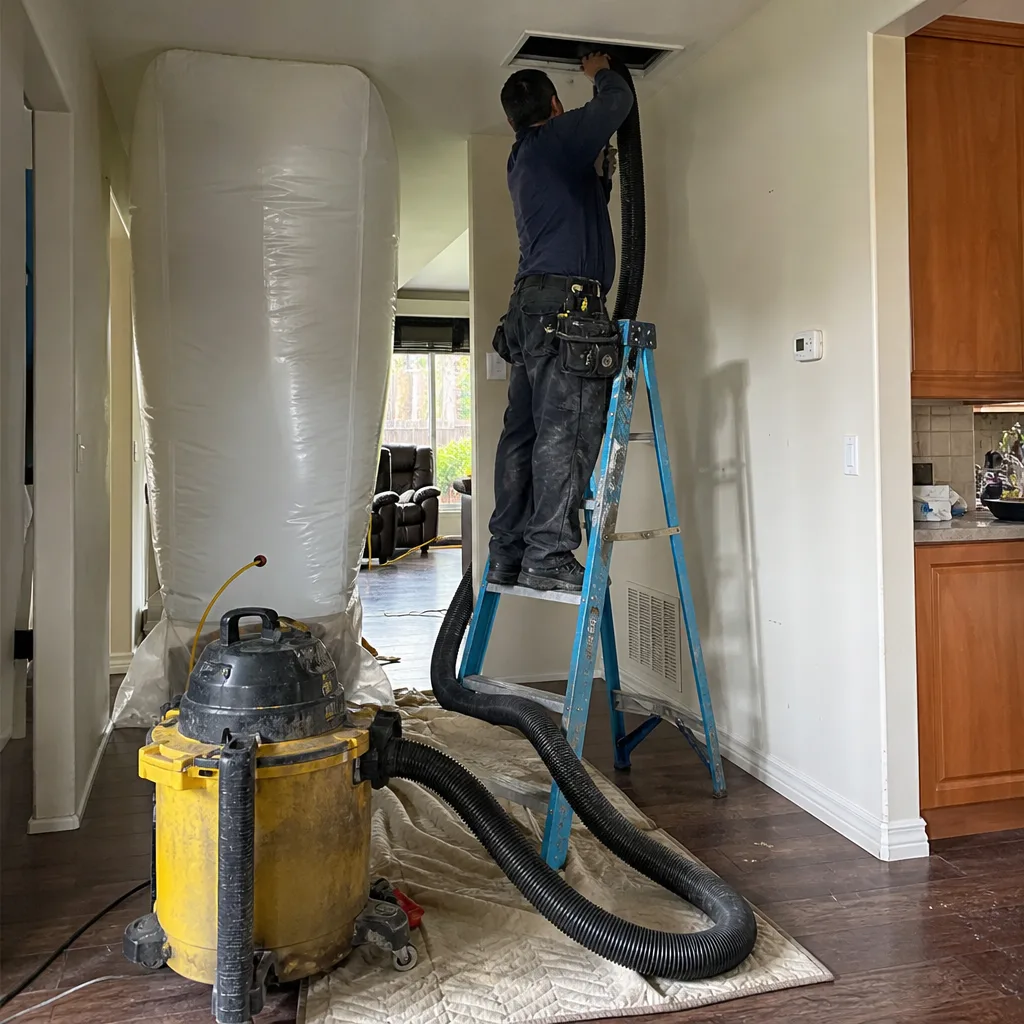
Last updated November 16, 2026
 Whole-home duct cleaning
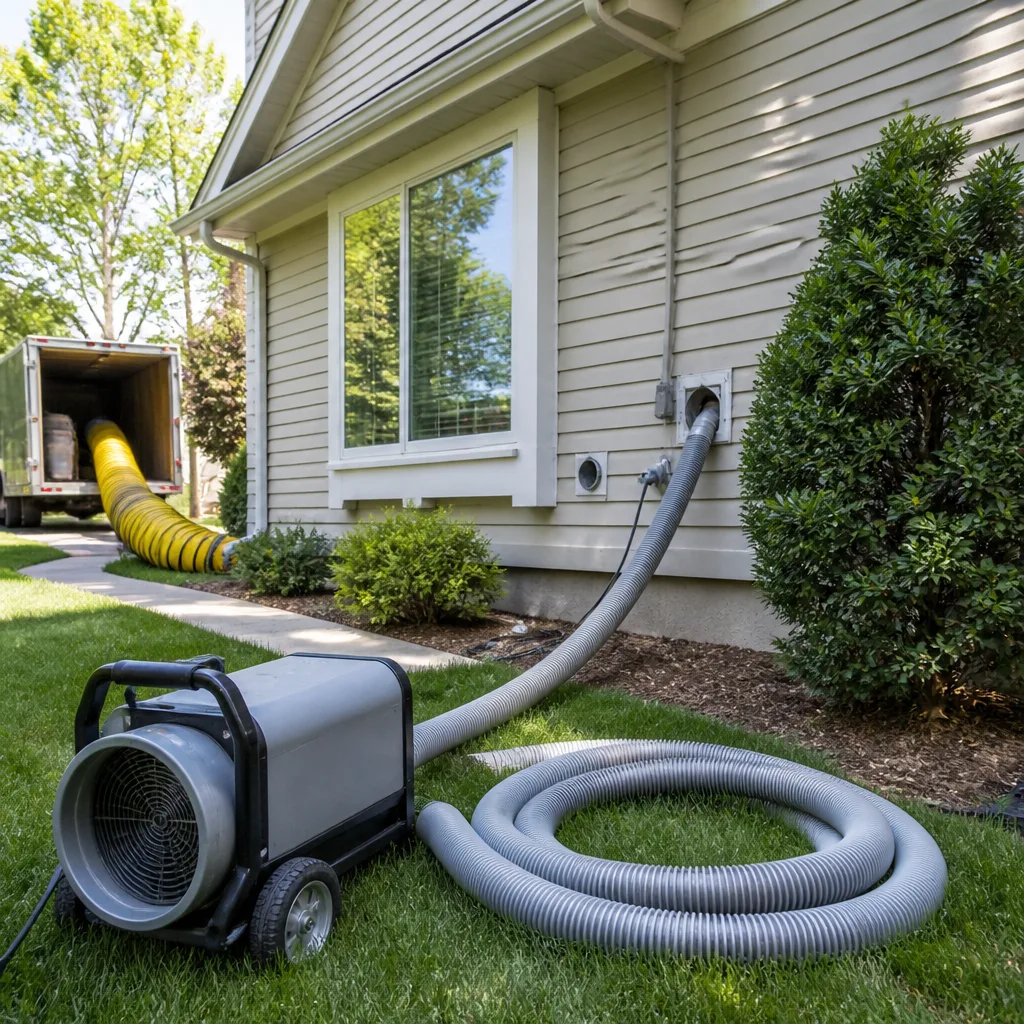
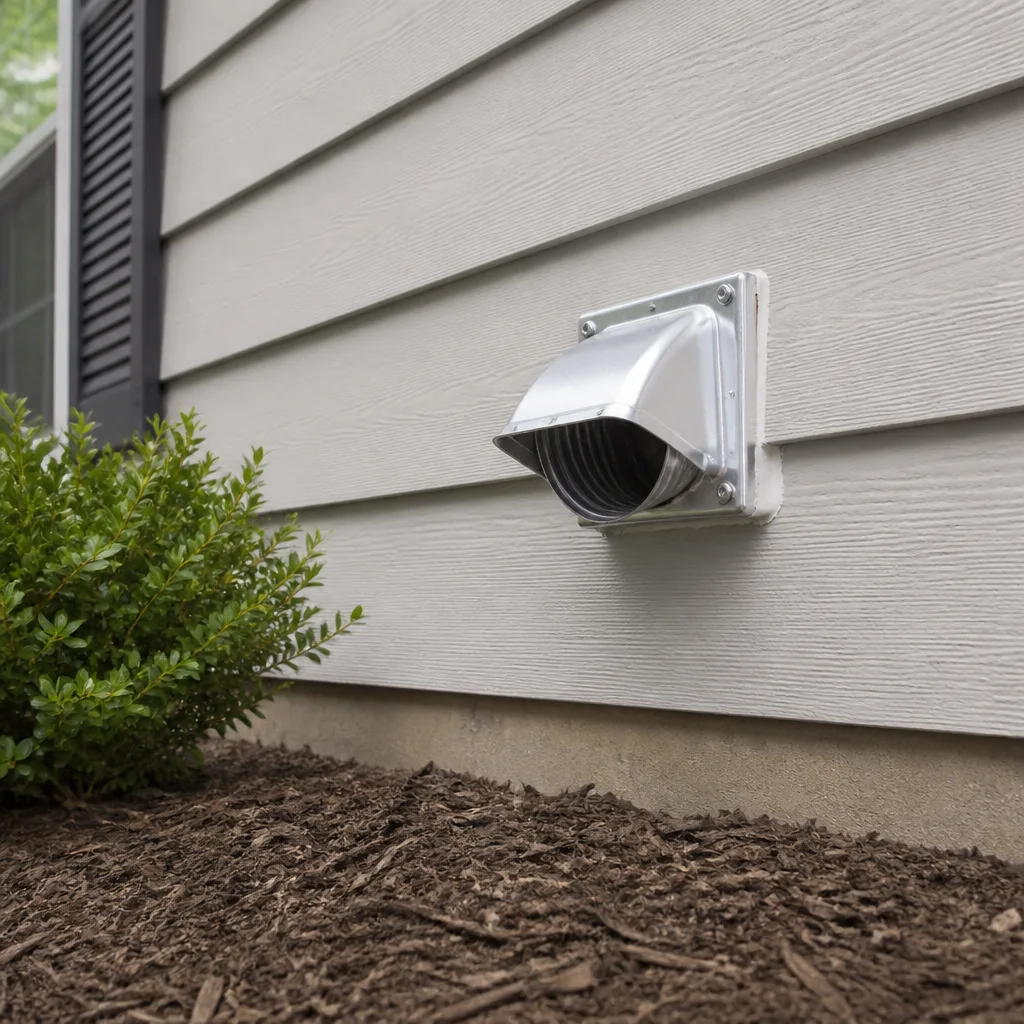 Dryer vent cleaning
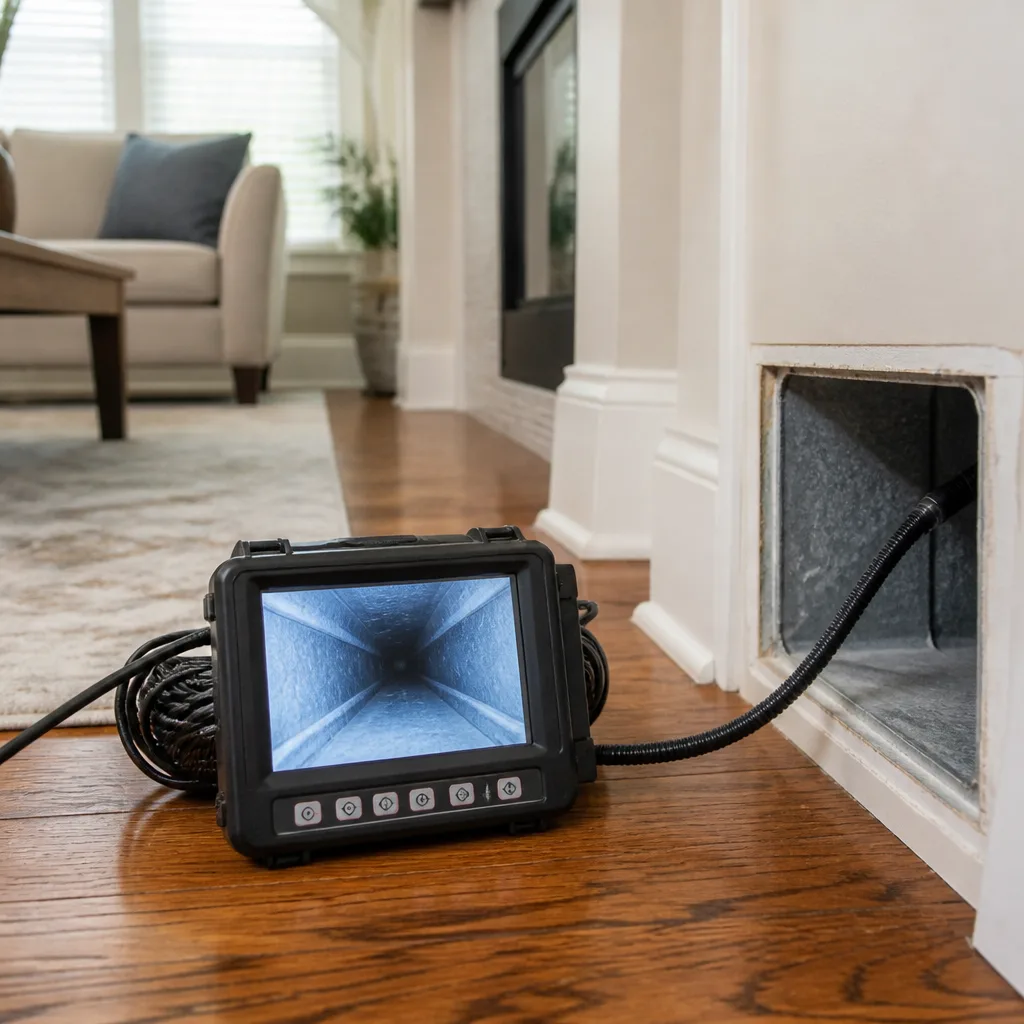 Camera inspection
 Sanitizing & deodorizing
Whole-system duct and dryer vent check with before-and-after photos - you see exactly what came out of your vents
That "$99 whole-house special" is a bait ad - the real number appears once they are in your hallway, or the "clean" is a shop-vac at the register. We photograph the inside of your ducts before and after instead.
Air Duct Cleaning Maintenance Checklist for Chico Homeowners
Changing your filter on January 1st is useless if you skip the post-harvest check in October, when orchard dust has already packed your return plenum. That’s the mistake most maintenance calendars make: they treat duct care as a monthly ritual when what actually stresses a duct system in Chico is a series of events. Wildfire smoke drifting down the valley. Almond and walnut harvest running for weeks. The first hot week when the air handler starts pulling full-time after months of quiet. Renovation dust. Dry months that load a dryer vent with lint faster than a wet climate ever would. This guide builds a checklist around those triggers instead of the calendar, and shows you which checks you can do at the register with no tools, and which findings mean it’s time to call a professional.
Quick Answer
A workable air duct maintenance plan for a Chico home is built around five event-triggered checkpoints: after wildfire smoke events, after harvest season, before the cooling season starts, after any renovation, and once a year on the dryer vent. Between those checkpoints, a homeowner should check filters and registers visually. A professional scope inspection with before-and-after documentation is warranted when you see dust streaking at registers, persistent musty odors, or a measurable jump in energy use. Our technicians have up to 12 years of experience, and one visit covers cleaning, safety, and repair.
Styles & brands we work with
- Whole-home duct cleaning
- Dryer vent cleaning
- Camera inspection
- Sanitizing & deodorizing
Table of Contents
- Why Calendar-Based Duct Maintenance Fails in Chico
- The Five Event-Triggered Checkpoints
- Filter Ratings: Matching MERV to Chico’s Air Quality Days
- The No-Tools Register Inspection
- DIY Check Versus Professional Scope Inspection
- Dryer Vent: The Parallel Maintenance Item
- Post-Renovation Duct Protection
- What Professional Work Should Document
Why Calendar-Based Duct Maintenance Fails in Chico
The standard advice you’ll find online is to clean ducts every few years and change filters monthly. That advice was written for a climate that doesn’t exist here. A duct system in Chico lives through a distinct seasonal pattern: a long dry stretch where particulate stays airborne, a harvest window that throws fine organic dust into the air across the valley, a summer where the air handler runs hard for months, and a winter that’s mild enough that the system rarely gets a break. Each of those stresses the ducts differently.
Fine dust from harvest and smoke events behaves differently from everyday household dust. It’s lighter, it travels deeper into the return side, and it settles in places a monthly filter swap won’t reach. Our technicians see return plenums that look clean at the grille and packed at the transition. That’s why the checklist below is built around events, not the first of the month.
There’s also the housing side. Much of Chico’s older housing stock has duct systems that were built before modern filtration was common, with flex runs and return paths that were never meant to carry the particulate load this valley delivers. A newer home in the same neighborhood may need a different cadence than a mid-century house three streets over. The event triggers stay the same; the response is what varies.
If you want the background on how a full professional cleaning works before you start the checklist, our Duct Cleaning Chico page covers the equipment and the process. The point for now is simpler: stop thinking in months and start thinking in triggers.
The Five Event-Triggered Checkpoints
These are the events that should pull you into action. You’re not trying to do a full cleaning at each one. Some checkpoints are a filter decision and a visual walkthrough. Others are a phone call. Set a reminder in your calendar for the events you can predict (harvest, cooling startup, renovation) and treat the unpredictable ones (major smoke events) as they come.
1. Post-Wildfire Smoke
When regional smoke settles into the valley, your filter is doing the work, and it’s loading fast. The response is not to clean the ducts immediately; the response is to change the filter as soon as the smoke clears, then check registers for fine ash deposits. If you find visible ash or dark dust blowing out at supply registers after a smoke event, the particulate has moved past the filter and into the system. That’s when a professional inspection is worth the call.
2. Post-Harvest Window
Late fall, once harvest equipment has stopped running, is the single most underrated duct checkpoint in Chico. That’s when orchard and agricultural dust that’s been suspended for weeks finally settles, and some of it settles into return systems. At this checkpoint, check the return filter for premature loading and inspect return grilles for fine sediment. If the return plenum looks packed, a cleaning is warranted before winter heating season.
3. Pre-Summer HVAC Startup
Before the first sustained hot week, walk the system. Check filter condition, look for dust streaks at supply registers, and check for airflow changes. A system that pulled fine dust all spring and now runs full-time is pushing that dust through the house all summer. Our air duct cleaning process is designed for exactly this moment, so the system starts the cooling season clean rather than carrying a season’s worth of accumulation.
4. After Any Renovation
Drywall dust, sawdust, and insulation fibers are heavier and more abrasive than everyday dust. Even with plastic containment, fine particles migrate. Cover registers during the work and do a full filter change plus register inspection afterward. Do not run the system on high while sanding is underway.
5. Annual Dryer Vent Check
The dryer vent is a separate system with its own timing. In a dry climate the lint load is high and the fire risk is real, so it gets its own scheduled checkpoint once a year, plus an immediate check any time loads start taking noticeably longer. We cover the details of that in the dryer vent section below.
Filter Ratings: Matching MERV to Chico’s Air Quality Days
A filter’s MERV rating tells you what particle sizes it captures. Higher is not automatically better. That’s the trap. A filter rated too high for the blower it’s installed in restricts airflow, and a restricted system loses efficiency and can strain the blower motor. The right call is a rating that matches what the air outside is doing this week, paired with one your equipment can actually handle.
On clear days in Chico, a moderate filter appropriate to everyday household dust does the job and protects airflow. On smoke or high-particle days, stepping up to a higher-capture filter makes sense, but only if your system has the blower capacity for it. If you’re not sure what your equipment can handle, ask before you buy: a filter that loads quickly and starves the system is worse than a lower rating changed more often.
Some homes here have filtration-grade equipment, and this is where brand matters. We install and service Honeywell and Aprilaire IAQ products, which gives homeowners a way to extend the job beyond cleaning into filtration you can actually measure. That matters on Chico’s smoke days, because a filter cabinet designed for higher-capture media won’t choke the blower the way an oversized disposable filter can.
Practical rules for filters in Chico:
- Change on a trigger, not a date. After a smoke event or at the end of harvest, not “on the first.”
- Check a loaded filter by looking at the return side. Heavy gray loading means it’s done.
- Don’t oversize the rating for convenience. Match it to the equipment.
- Keep a spare on hand before smoke season and before the first hot week, so you’re not shopping in a hurry.
The No-Tools Register Inspection
You can do a genuinely useful inspection of your duct system at the registers with nothing in your hands. No flashlight, no camera, no tools. It takes ten minutes and gives you a baseline you’ll compare against at the next checkpoint. Here’s the routine:
- Wipe a white cloth across a supply register. Light dust is normal. A dark smear or something that smears like soot means particulate is reaching the register. Note it.
- Look at the grille and the visible duct behind it. Streaking around the duct boot means dust is depositing at the transition, which often means it’s settling in the run behind it.
- Turn the system on and hold the cloth near the register for a minute. If visible dust blows out, the ducts are releasing particulate into the room, not just holding it.
- Smell the supply air. A musty or stale smell that wasn’t there last checkpoint is a signal. Note where in the house it’s strongest.
- Check returns for sediment. Look at the return grille for fine sediment, especially after harvest or a smoke event. Fine grain or ash-colored deposits are worth writing down.
- Listen at the register. A whistle, a rattle, or a whoosh that’s louder than last time can indicate a leak or a disconnected run.
- Note room-to-room differences. If one room is consistently weaker than the others, write down which room. That pattern is useful information for a professional.
Keep a short log: date, checkpoint (post-harvest, pre-summer, etc.), what you found. A written record turns “the house feels dusty lately” into a specific, dated observation. If you decide to call, that log makes the conversation faster and it tells the professional you know your own system. It’s the kind of detail orientation that separates a real inspection from a guess.
The clues that matter most: dust blowing from registers when the system runs, dust streaks around the duct boot, persistent musty odor, and a visible bulge or torn insulation on an accessible duct segment.
DIY Check Versus Professional Scope Inspection
Here’s the line we’d draw. The homeowner check covers the visible face of the system: registers, filters, and the operational signals (smell, airflow, sound). A scope inspection goes inside the ducts, where you can’t see and where the real condition lives. The two aren’t in competition. The DIY check is what tells you whether you need the scope.
Findings that call for a professional scope inspection:
- Dust blowing out of supply registers while the system runs.
- Persistent musty or stale odor that returns after filter changes.
- Visible debris, sediment, or ash deposits at returns.
- A room that’s consistently weaker than the others, with no obvious cause.
- Evidence of pests or rodent activity at a register or in accessible duct.
- A recent renovation without containment.
- A dryer vent that takes noticeably longer to dry a load.
What the scope inspection actually looks like: we run a camera into the system, capture stills and video, and show you the condition before any work is agreed. You see what we see. Then we agree on a scope and a price before we start. That’s the difference between a documented inspection and a bid off a flyer. In a trade with a bait-and-switch reputation, seeing your own ducts on a screen and knowing the price before work starts is the whole point.
Our technicians have up to 12 years of experience, and the equipment matters here: Rotobrush and Nikro systems used by commercial and restoration professionals, plus Abatement Technologies air-filtration equipment that captures dislodged particulate rather than recirculating it. That’s the containment-and-capture standard. Captured and removed, not just loosened. It’s why we can show you before-and-after photos and why the work holds.
Dryer Vent: The Parallel Maintenance Item
The dryer vent is not part of the HVAC duct system, but it’s the most safety-critical maintenance item in the house, and Chico’s climate gives it its own timing. Lint is dry and fluffy in a dry climate, and it loads the vent faster than you’d expect. A clogged dryer vent is a leading residential fire cause. That’s a safety outcome, not just a comfort one.
Timing that actually fits Chico:
- Once a year at minimum, on a scheduled date you’ll remember.
- Immediately if loads take noticeably longer to dry or the dryer runs hot to the touch.
- Before and after any period where the dryer is running several loads a day (a house full of guests, a big laundry week).
- Any time you smell the dryer getting “hot” near the vent.
What a homeowner can check safely: pull the dryer out (if it’s safely accessible), disconnect the vent, and look for visible lint accumulation at the dryer end and behind the flap. You’ll often see a dense felt-like mat. That’s the signal. If the run is long, insulated, or goes up to the roof, don’t try to clean it from the dryer end. Our dryer vent cleaning process removes the full accumulation, not just the accessible lint, and we document what came out. One visit covers cleaning, safety, and repair, so if we find a crushed vent or a torn duct, it’s fixed on the spot rather than scheduled for a second appointment.
Post-Renovation Duct Protection and Repair
Renovation dust is a maintenance event, not a nuisance. Drywall dust is fine, abrasive, and it takes weeks to fully settle out of a house. Put plastic over registers before the work starts. Keep the system off during demolition and sanding. Change the filter as soon as the work ends, then do a register inspection.
What renovation often reveals: duct runs that came loose under a floor or in a wall, insulation that’s torn or compressed, and connected boots that no longer sit flush. These are repair items, not cleaning items, and they’re the reason cleaning and repair belong under one contractor. Our work covers the full lifecycle: cleaning, dryer vent safety, and structural air duct repair, so a problem found during cleaning is fixed on the spot.
If your renovation included moving a wall, adding a room, or relocating a return, that’s a legitimate scope inspection trigger. New framing can leave a run disconnected or undersized for the room it serves, and you’ll feel that as a weak register. Better to catch it before the finish work hides it. If you’re not in Chico proper, our Chico page lays out where we work.
What Professional Work Should Document
Partial cleaning is the most common shortcut in this trade. A technician hits the accessible runs, uses a shop vacuum on the visible portion, and calls it clean. Nothing is documented, and you have no way to know what was actually done. The antidote is documentation. Ask for it, and expect it.
What a documented professional job includes:
- Before-and-after photos of your own ducts, not stock photos.
- A scope of work agreed before the job starts, so the price doesn’t move.
- A plain description of what came out and where.
- Specific findings: a loose run, a damaged boot, a crushed dryer vent, a filter cabinet that needs a better filter.
- An itemized list of any repair that was done, with the price agreed in advance.
- Cleaning clearly separated from repair on the invoice, so you know what you paid for.
The finish process matters too. We use Guardsman-line products as part of a finish step, which is a signal that the job isn’t finished when the vacuum stops. Details beyond the duct opening are what separate a real cleaning from a quick pass. If a contractor won’t document the work or won’t agree on a price before starting, that’s your cue to get another estimate.
Common Mistakes to Avoid
- Changing the filter by date instead of by event. A filter changed on January 1st may be saturated by the time harvest dust settles in October. Change on trigger, and check the loading at each checkpoint.
- Oversizing the filter rating for convenience. A filter too restrictive for your blower cuts efficiency and can strain the motor. Match the rating to your equipment, especially on smoke days.
- Assuming a clean register means a clean duct. Registers look clean long after the runs behind them have accumulated dust. The visible face of the system tells you very little about what’s inside.
- Running the system during renovation. It pulls drywall dust straight into the ducts. Cover the registers and keep the system off until the work ends.
- Skipping the dryer vent because the dryer still works. A still-working dryer can be one load away from a serious problem. The vent is a safety item, not a comfort item.
- Accepting a bid without a scope or documentation. A low price with no written scope and no before-and-after photos is the bait-and-switch pattern. Get the scope and the price in writing first.
- Treating cleaning and repair as separate contractors. Problems found during cleaning should be fixed on the spot. A second appointment at a second price is avoidable when one contractor covers both.
See the difference
 Before
 After
 Before
 After
 Before
 After
When to Call a Professional
Call when the checklist gives you a signal you can’t resolve: visible dust blowing from supply registers, persistent musty odor, sediment at returns after harvest or smoke, a weak room with no obvious cause, evidence of pests, or a dryer vent that’s loading fast. Call when your pre-summer filter change and visual check leave you unsure whether the system is actually clean. And call when a renovation left dust in the system and you want a documented scope inspection before the next season starts. Duct Cleaning Chico offers free estimates in Chico. Call (866) 942-5531. We answer 24/7. Fast dispatch from 7am to 7pm, Sunday through Friday, closed Saturday. One visit covers cleaning, safety, and repair, and we agree on a flat price before work starts.
Frequently Asked Questions
There’s no single number of years that works for every home in Chico. Build the schedule around events instead: after a significant wildfire smoke event, after harvest season, before summer HVAC startup, and after any renovation, plus an annual dryer vent check. Between events, check filters and registers visually and keep a short log. If you want a documented scope inspection at any point, call (866) 942-5531 for a free estimate.
The right filter is one your equipment can handle at the highest capture level it will tolerate without starving airflow. Step up on smoke days only if your blower has the capacity, and step back down when the air clears. If you’re not sure, ask before you buy, and check the filter’s loading at each checkpoint. A filter that loads fast and pushes the blower isn’t doing the system a favor.
You can do a genuinely useful inspection at the registers with no tools: wipe a cloth across supply registers, check returns for sediment, smell the supply air, and note room-to-room airflow differences. That routine tells you whether you need a professional scope inspection. It doesn’t replace one. What it does is turn a vague feeling into a specific, dated observation.
A slow dryer usually means a loaded vent, and Chico’s dry climate loads a vent with lint quickly. Check the dryer end of the vent for a visible lint mat and schedule a vent cleaning if a load takes noticeably longer. It’s a safety item, not just a convenience. Call (866) 942-5531 for a free estimate on a dryer vent cleaning.
Not every smoke event requires a cleaning, but every smoke event loads the filter hard. Change the filter when the smoke clears, then check registers for fine ash or dark dust. If you see ash blowing from supply registers or dark dust at returns, the particulate has moved into the system and a professional scope inspection is worth the call. Call (866) 942-5531 and we’ll tell you what we’d recommend after seeing the system.
You know when you have before-and-after photos of your own ducts, a scope of work agreed before the job started, and an itemized invoice. Ask for all three. The bait-and-switch pattern in this trade relies on you not being able to see inside your own ducts. A contractor who documents the work takes that uncertainty away, and if a repair turns up during cleaning, we fix it on the spot with a flat price agreed in advance.
The Bottom Line
The maintenance checklist that works for a Chico home is built around events, not calendar quarters. Post-wildfire smoke means a filter change and a register check. Post-harvest means a return inspection before heating season. Pre-summer means a walkthrough before the air handler runs full-time. Renovation means containment and a register check afterward. And once a year, the dryer vent gets its own dedicated check, because it’s a safety item. Do the ten-minute no-tools inspection at each trigger, keep a short log, and call when the checklist gives you a signal you can’t resolve. Professional-grade equipment, residential pricing, and one visit that covers cleaning, safety, and repair: that’s the standard to hold any contractor to.
If your checklist turns up something that needs a professional, call Duct Cleaning Chico at (866) 942-5531 for a free estimate. We answer 24/7. Fast dispatch from 7am to 7pm, Sunday through Friday, closed Saturday. Our technicians have up to 12 years of experience, and every job comes with before-and-after photos and a flat price agreed before work starts.
Written by the team at Duct Cleaning Chico.